


BEVs, PHEVs, HEVs, ICE, and the Current Status of Vehicle Electrification
If you follow the auto industry at all, the topic of electrification is unavoidable. Manufacturers are releasing new EVs and hybrid vehicles seemingly on a weekly basis. Toyota, which was at the forefront of hybrid vehicles with its Prius, now has several model lines that are hybrid only, including the 2025 Camry. A few years ago, automotive brands seemed to compete over who would have a 100% electrified lineup within the next decade; most of these brands have now adjusted their plans. To help you navigate this changing automotive landscape, Alderman Automotive, with assistance from electronics industry analysts Electro lQ, has some statistics to show you the brand-agnostic status and trends of automotive electrification.
Electrification is a broad term that applies to any vehicle that is at least partially powered by one or more electric motors. This includes:
- Battery Electric Vehicles (BEVs)—Vehicles that operate entirely from energy stored in batteries that are charged from the electrical grid.
- Hybrid Electric Vehicles (HEVs)—These models draw no power from the grid but use batteries charged by engines or brake regeneration. These batteries assist the gasoline engines in acceleration and may drive the wheels alone electrically for short distances at slow speeds, like backing out of driveways or in parking lots.
- Plug-in Hybrid Vehicles (PHEVs)—These vehicles are designed similarly to HEVs but feature larger batteries that can draw power from the grid and operate solely on electricity at normal speeds for 20 to 50 miles, depending on the model.
These are all in contrast to conventional 100% internal combustion engine (ICE) vehicles that run on gasoline or diesel (with no motor assistance).
Market Share
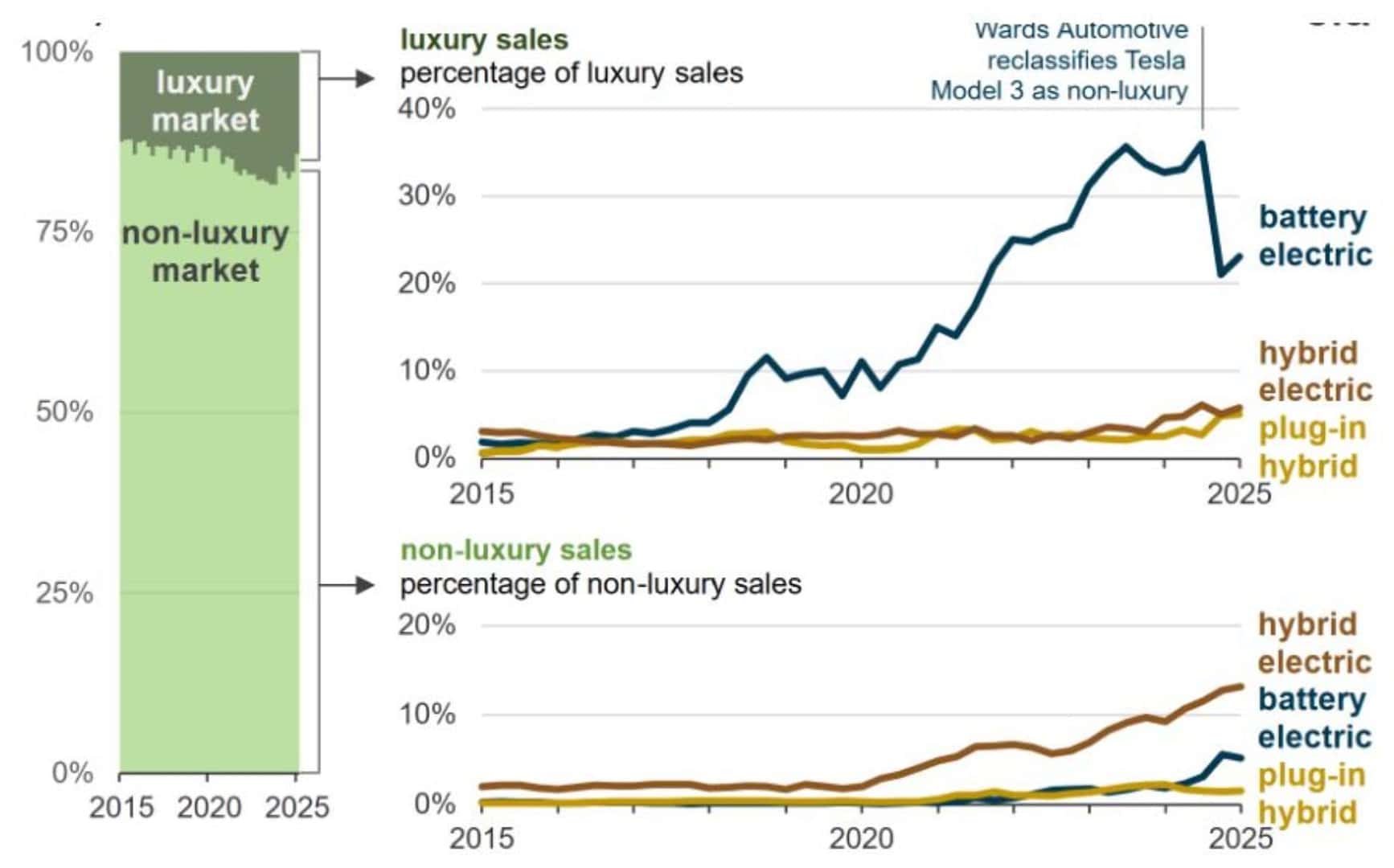
ICE models still dominate sales, but electrified vehicles are gaining in market share:
| Fuel Type | ICE | BEV | HEV | PHEV |
|---|---|---|---|---|
| Q1 2023 | 86.4% | 6.8% | 6.3% | 0.57% |
| Q4 2024 | 75.1% | 7.4% | 14.8% | 2.6% |
As can be seen, the largest increase in electrification comes from hybrid models, which are available on many more models these days. Toyota leads the way with several hybrid-only models and hybrid versions of almost every model it sells. Forty percent of Toyotas sold in 2024 were hybrids. Of course, Toyota isn’t alone. With Nissan as a notable exception, nearly all Asian brands offer hybrid versions of their most popular models. Hybrid models can also be found among key domestic offerings.
Plug-in hybrid models are less common, but options are available in popular vehicles like the RAV4, Hyundai Tucson, Chrysler Pacifica, Jeep Wrangler, and Grand Cherokee. Many industry experts anticipate a significant increase in PHEVs, as they only require minor adjustments to existing hybrid models. The appeal of PHEVs lies in their ability to handle many people’s daily driving needs solely on electricity, while longer trips can be managed without the need for charging. Additionally, most PHEVs can fully charge overnight using a standard household outlet.
BEVs reached as high as 8.72% market share in Q1 2024 before declining slightly. This decrease occurred despite the influx of more BEVs into the market. Concerns about insufficient public charging infrastructure, along with a significant decline in sales of market leader Tesla for external reasons, can be seen as contributing factors to this drop, which is expected to be even larger in the first half of 2025.
Vehicle Costs
Electric vehicles remain more expensive than comparable ICE models or hybrids. The average cost of a BEV is $58,940 compared to $48,916 for ICE models, $41,995 for PHEVs, and $32,975 for HEVs. While battery cost contributes to this issue, BEVs are often built on higher-end models, including luxury sedans and full-size pickups or SUVs. There are very few BEV versions of economy cars, with Chevrolet’s now-discontinued Bolt being a major exception. The irony is that the daily commute and short-distance driving tasks typically performed by small, efficient vehicles are where BEVs excel, while larger vehicles are often relied upon for long-distance driving—more of a limitation for BEVs.
Operating Costs and Resale Value
BEVs tend to have a comparatively lower resale value, likely due to shoppers’ fears that they will need to replace the batteries. Battery replacement is quite expensive, but also fairly rare. Based on a recent study by Recurrent Auto of over 20,000 BEV models, only 2.5% have had a battery replacement.
In the meantime, BEVs will be less costly to operate. Electric rates vary, but on average, BEV owners who charge at home can expect an operating cost of about 4¢ per mile, compared to 10.1¢ for ICE models and about 8¢ for HEVs. PHEVs vary based on how often their gas engines are used.
With essentially no maintenance costs for the drivetrain, EVs have lower maintenance costs per annum, estimated at $300 to $550. Hybrids that still have the usual oil and filter changes and other ICE maintenance needs cost about $600-$1,000 per annum.
Conclusion
Electrification is not a fad. In the coming years, we can expect even more EVs entering the market, along with additional HEV and PHEV versions of familiar ICE models. At the same time, the public charging infrastructure will improve, and at least some of the predicted breakthroughs in battery capacity will materialize. Eventually, they may dominate the industry, but that is likely to take longer than many industry analysts initially predicted.
By definition, there is a lag between what is occurring in the industry and how it appears in the Alderman Automotive used vehicle inventory. Many electrified vehicles are still with their original owners, so they have yet to return to the market. However, we can expect that to change in the coming years. At any time, you can check for electrified vehicles in the Alderman Automotive inventory by selecting the Fuel Type filter and clicking on the drivetrain of your choice. Alderman Automotive will assist you in your transition to electrified transportation when or if the time comes.
0 comment(s) so far on BEVs, PHEVs, HEVs, ICE, and the Current Status of Vehicle Electrification