


The Detection And Consequences Of A Suspension Out Of Alignment
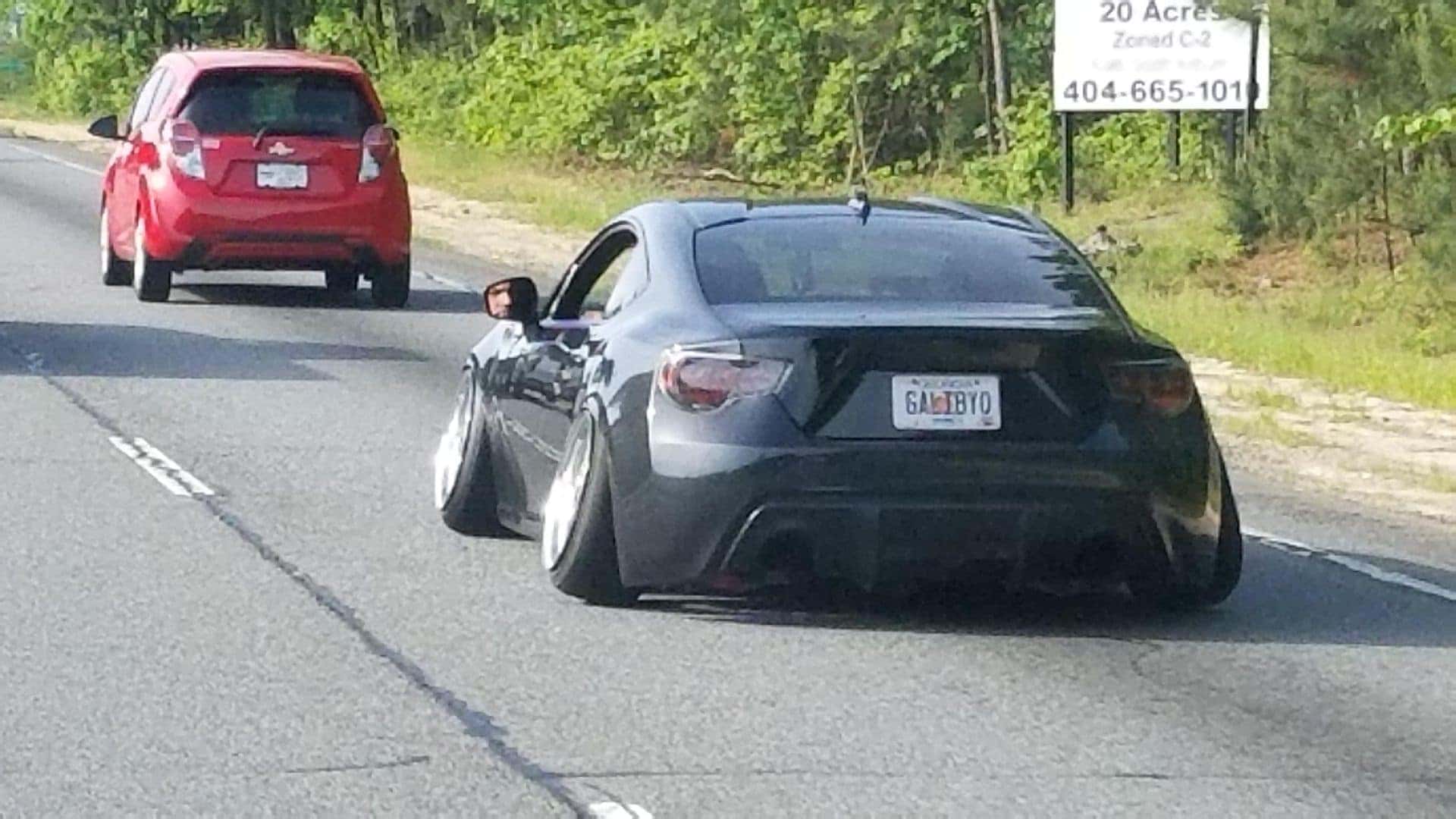
Suspension alignment refers to the angle of your tires in relation to the ground and each other. Hitting a sharp pothole, curb, or another hard impact on the road can cause one or more tires to become misaligned. Misalignment can also happen when certain suspension parts have become excessively worn. If you suspect you have an alignment issue, Alderman Automotive advises that you get the alignment corrected before it costs you more money or even destabilizes your vehicle down the road.
If you have been fortunate enough never to experience a car or truck with a misaligned suspension, you have likely felt it with a shopping cart. You instantly recognize that the cart isn’t quite right as it steers to one side and may be harder to push than normal.
The effect is similar but more subtle in the car. Power steering mitigates the sensation, but you may start to notice your car’s tendency to drift to the left or right. At first, you are likely to subconsciously self-correct, but when you keep your car going straight by resting your hand on one side of the steering wheel and letting the weight of your arm compensate for the pull, it is definitely time to get your alignment checked.
Another symptom is when your car starts to shake or shimmy at certain speeds. It may worsen as the speed increases or even settle down, but it still indicates that you have a problem. This can also be the symptom of one or more tires being out of balance.
The Three Ways Your Tires Can Be Misaligned
There are three ways your suspension can be misaligned, and they involve the Camber, Toe, or Caster of your wheel alignment.
Camber
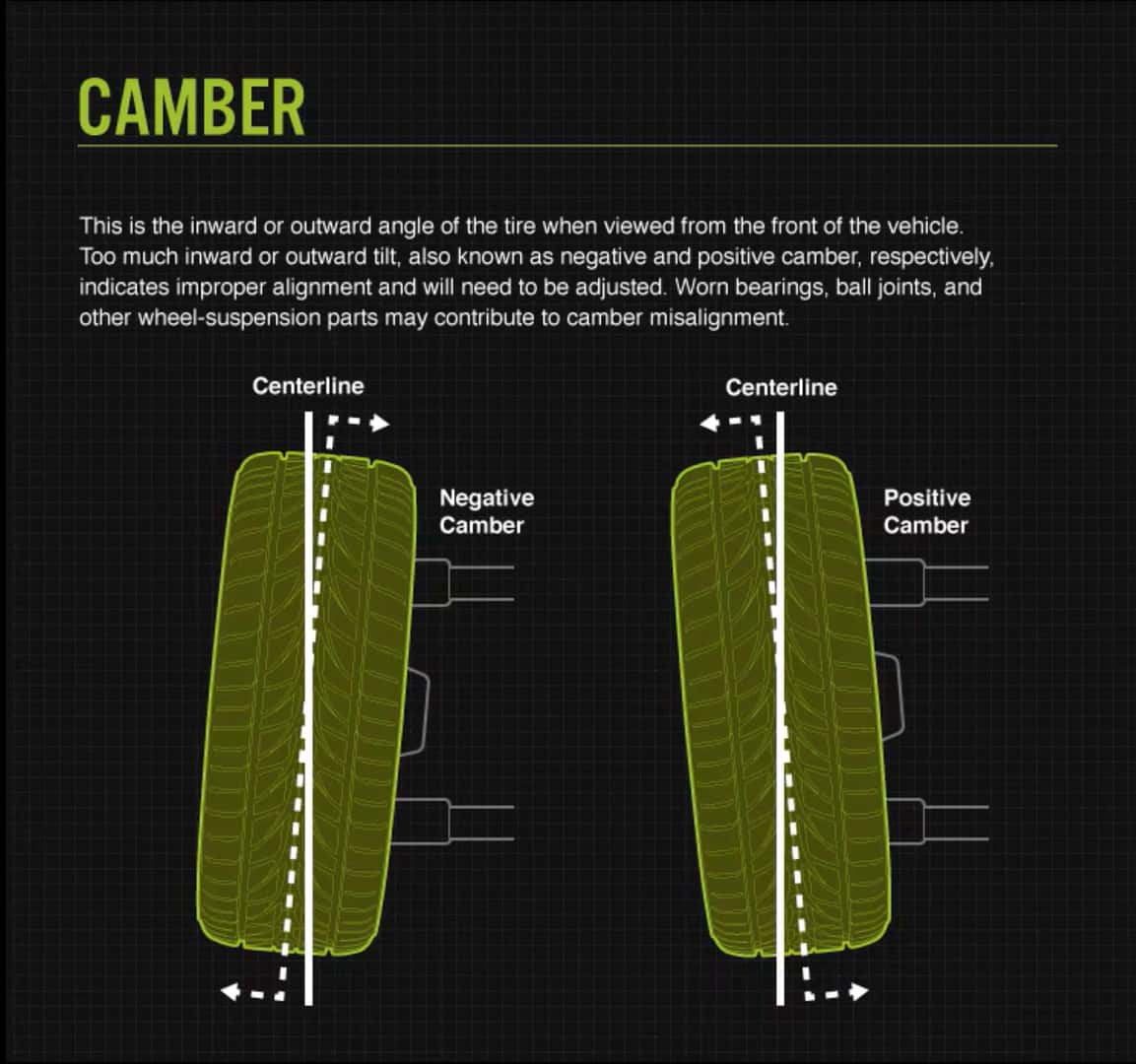
This is the inward or outward angle of the tire when viewed from the front or back of the vehicle. Instead of the tire sitting straight up, it may be angled slightly outward at the top (Positive Camber) or inward at the top (Negative Camber). You may have witnessed an exaggerated example of negative camber on a car where the owner added aftermarket wheels with the bottom slanted outward. The owner may like this look, but you can see how the inner corner of the tires will be worn prematurely, and that handling can be impacted by the altered tire patch on the road. Usually, camber misalignment is not so obvious to the naked eye until you see noticeable wear on either the inside or outside of the tire. It should be noted that positive is not better than negative. Both deviate from the ideal. Worn bearings, ball joints, and other wheel-suspension parts can be causes of camber misalignment.
Toe
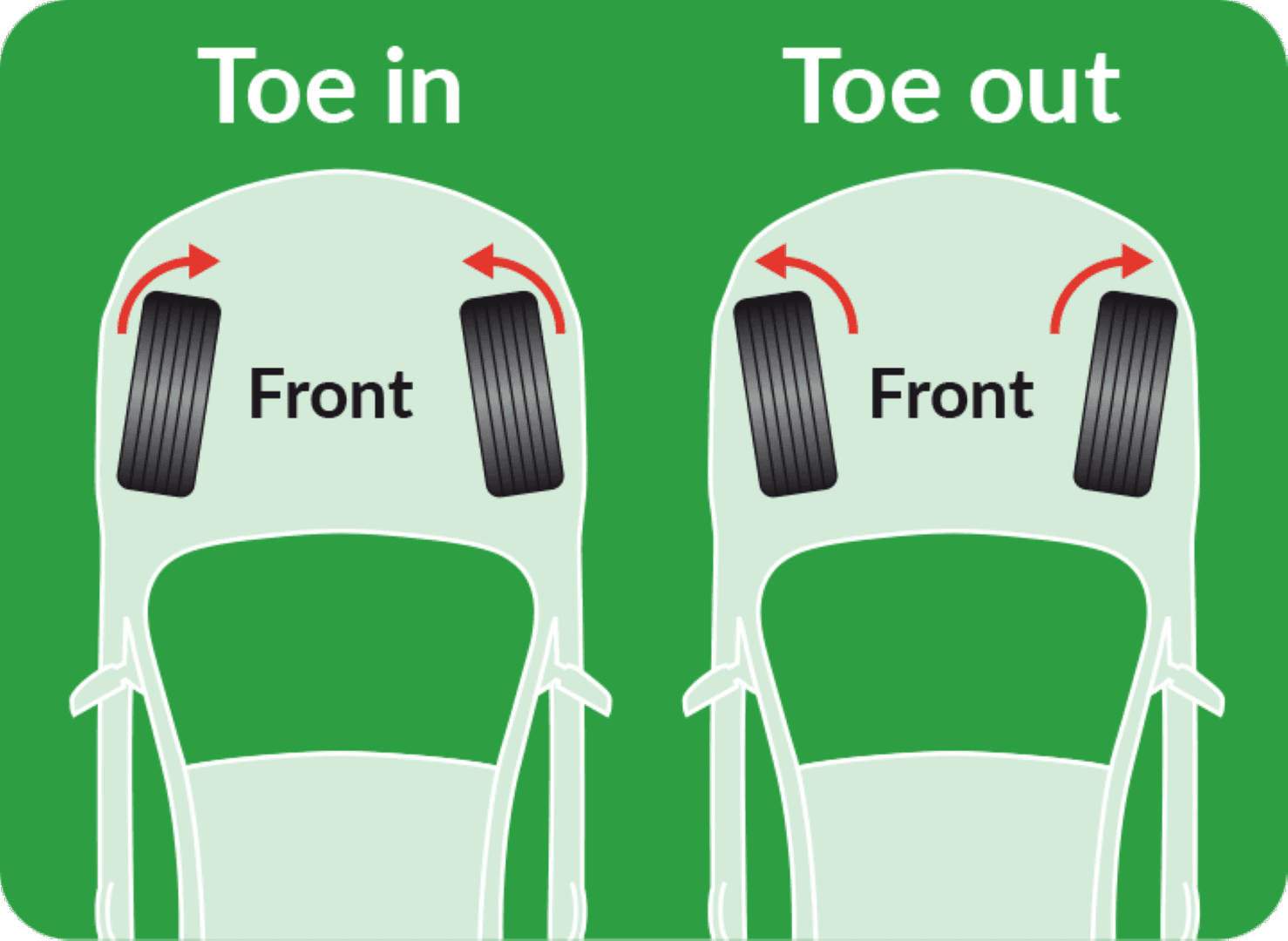
Toe misalignment is often the most common issue and is felt when the car drifts to one side or the other. To visualize two misalignments, stand up and look down at your feet. If you swivel one or both feet inward so that the toes move closer together, your toes are said to be inward, and when this occurs with your tires, it is descriptively called Toe-In. Toe-in alignment on your tires will cause the pavement to scrub the outer side of the tire tread, leading to both premature tire wear and reduced fuel mileage due to the increased resistance of forcing the tires to move at an angle.
Swivel one or more feet in the opposite direction so your toes are angled outward in relation to each other. When your tires do this, it is called toe-out. Toe-out can also cause premature tire wear and make it more difficult to keep the vehicle headed in a straight line, as at least one tire tries to veer off to the side. This impact on your steering can be caused by toe issues on either the front or rear wheels. Again, toe misalignment on your tires can be felt, but it is difficult to see with your eyes.
Caster
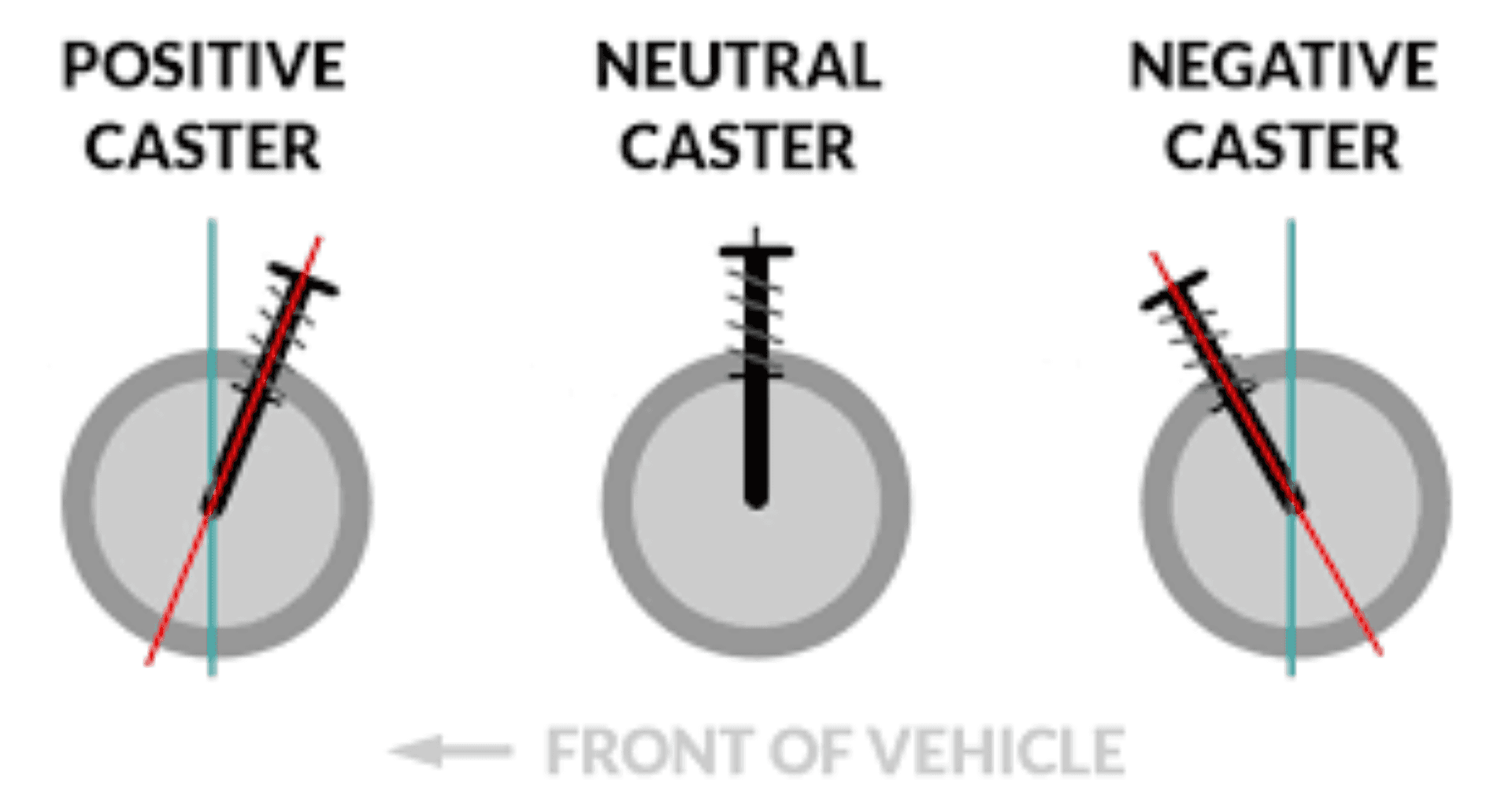
Caster primarily concerns the front wheels and the angle at which they steer. To picture this, imagine holding the pointed end of a pencil by two fingers with the eraser pointed straight down, resting on a table or desk in front of you. Now, envision a wheel attached at its center to the side of the eraser so it can roll forward or backward. When you rotate the pencil, the wheel “steers” to the left or right. If the pencil is aimed straight down while you steer the wheel, it swivels correctly at “Centerline.” If you angle the top of the pencil toward yourself, representing the rear of the car, that is called Positive Caster. Conversely, if you angle the pencil top forward, that is Negative Caster. Once again, positive is not better than negative. Both can reduce your vehicle’s stability in a turn and, like the other two issues, increase tire wear.
Realignment
Correcting alignment is not something you can effectively accomplish at home. Unless it is comically bad, these misalignments are unlikely to be detectable by sight, so it takes special tools to determine the type and degree of misalignment and ascertain whether subsequent adjustments can bring things back to the original vehicle specifications.
Of course, the Alderman Automotive Service Department is fully equipped to handle this procedure. So, if you notice your car pulling to one side or the other or shaking at certain speeds, contact Alderman Automotive to have your alignment evaluated and corrected.
0 comment(s) so far on The Detection And Consequences Of A Suspension Out Of Alignment