


What to Check on Tires Before You Buy
When looking at a used car, never overlook that no matter how powerful the engine or how sophisticated the suspension and related technologies, the only real contact the car has with the rest of the world is through its tires. At some point, all tires need to be replaced, and fortunately, tires are the easiest part of the car’s mechanical system when it comes to understanding how long they will last. Alderman Automotive informs you how.
It may be a time-honored tradition, but it will likely not surprise you that kicking the tires yields very little useful information. Your eyes can tell you much more.
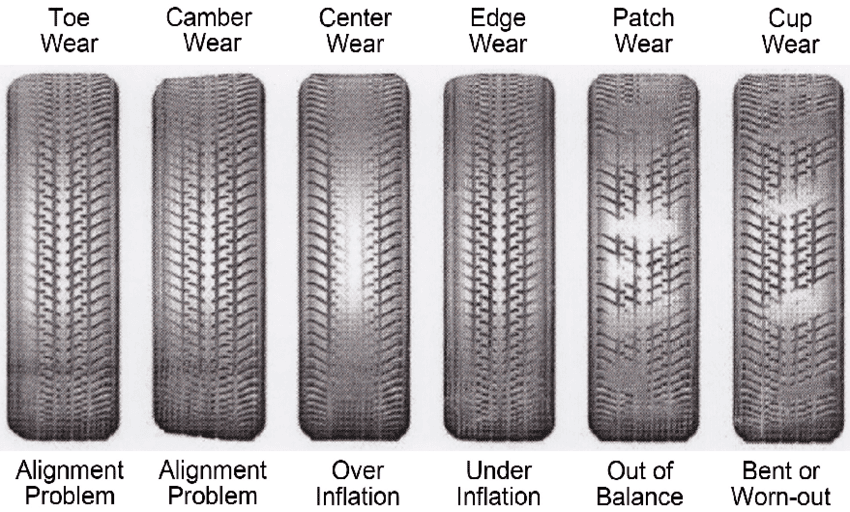
Do the Tires Match?
First, you will want to consider if all the tires are the same brand and model. This isn’t absolutely necessary, but different tires have different traction and handling characteristics, so mismatched tires can make the car handle and brake less than optimally. Ideally, they will all be the same type of tire. At the least, each tire should match the one on its opposite side. If those are mismatched, see about getting them replaced. Mismatched tires also tell you something about how meticulous or cheap the previous owner was in maintaining his or her vehicle.
Measuring Tread Depth
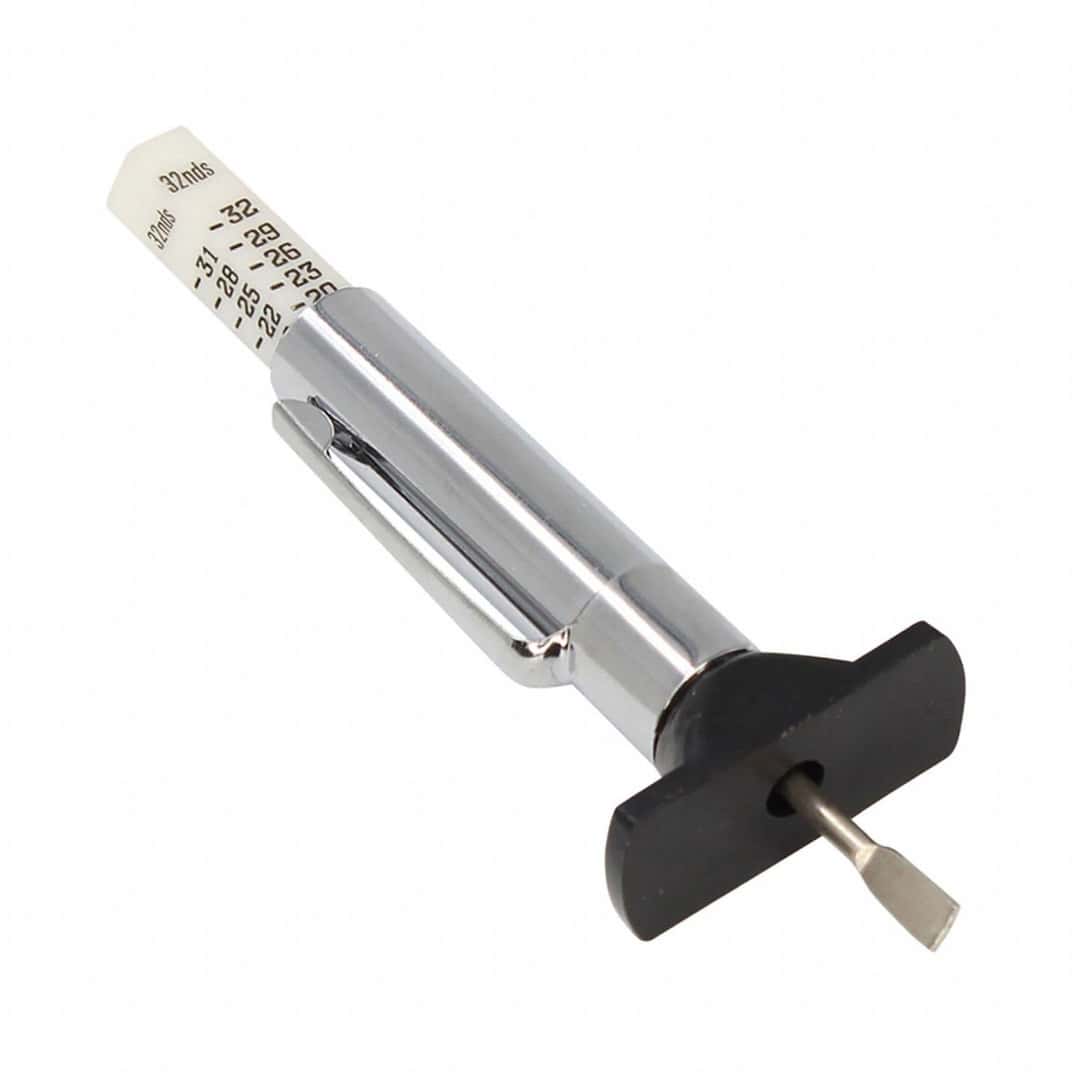
The next step is to measure the degree of tread wear. There are a couple of ways to do this. Ideally, you will use a tread depth gauge. This is an easy-to-use, inexpensive tool that you can find at any auto parts store, and if you are used car shopping, it is worth your time and money to get one. You place the gauge on the tread where the movable center tube or sleeve can be pushed between the treads. Read the measurement on the center, which is just about to be covered up. A new car tire typically has a tread depth of 10⁄32 or 11⁄32 of an inch, while a light truck will have between 11⁄32 and 19⁄32 of an inch. Tires with tread at 2/32 of an inch or below should be replaced immediately. Where the tread depth appears between these figures gives you an idea of how much life there is left in the tire. Do this on more than one location of each tire. This is not the time for averaging; The thinnest tread is the one by which you judge. Also, remember that tread that is significantly more worn on one side of a tire indicates an alignment issue.
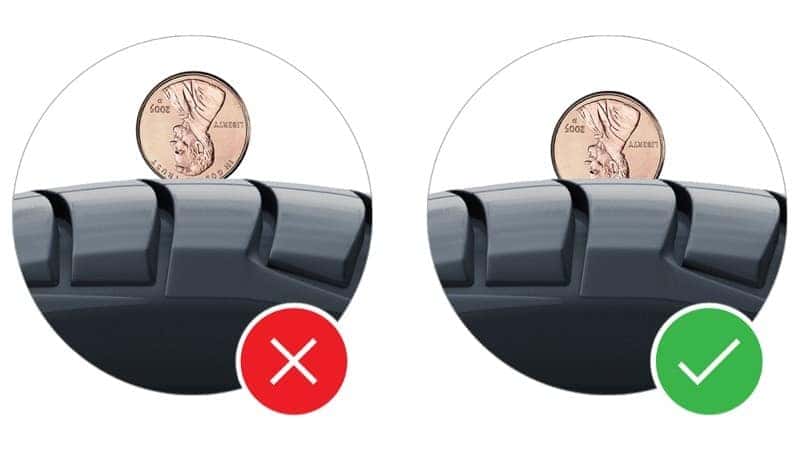
If you don’t have a tire depth gauge, there is always the penny test. In this case, slot a penny between the treads. If you can see all of Lincoln’s head, including his hair, the tire needs to be replaced. A tread that covers the hair will be good for a while, and if it covers part of his for=ehead, even better. If it covers his entire head, chances are you are looking at a new off-road tire.
Reading Tire Age
Tread depth is important, but it isn’t the only thing to inspect. Tires age even when they are not being used. They oxidize over time, making them hard and brittle. This reduces their traction, which in turn, reduces stability in turns and increases braking distances. Tires are generally made to last ten years, but the rule of thumb is to replace them after six years. Thus, if you are looking at a car driven by the proverbial old lady who only took it to church on Sunday, the tires may need replacing despite having plenty of tread left.
Fortunately, checking a tire’s age is even easier than checking its depth. That is because all tires have their birthday stamped on them. Actually, it is their birth week. Tires have a lot of writing on their side, but you want to look for a string of characters starting with the letters “DOT.” Four numerals are at the end of that string of characters, and a little separated from the rest. The first two are the week of the year the tires were made, and the last two indicate the year. Thus, “2621” indicates the tires were made in the 26th week (late June) of 2021. Again, if the tires are over six years old, even if the tread looks great, you should consider having the seller replace them or discounting the price accordingly so you can replace them soon.
If this is a car at Alderman Automotive, such work can easily be done at our Service Department, which can subsequently handle tire rotations and most other maintenance work for your recently purchased vehicle. When you are in the market for a used car, we invite you to look at all the tires in our inventory—and the cars attached to them.
0 comment(s) so far on What to Check on Tires Before You Buy